
Tax law evolves extremely slowly, like the drip-drip-drip growing into a mighty glacier. And like glaciers, a tax law can survive for centuries – long after the war, the emperor, or the overworked civil servant that created them.
This week, we’re looking at five taxes that are in it for the long haul. Some haven’t changed a lot, while others have had a little modernisation. From levies used to fight Napoleon to taxes relying on your religious affiliation, there’s a richer seam of history in our tax codes than most people realise.
🏛️ 1. Stamp Duty (UK)
Stamp Duty was introduced in 1694 to fund the British war against France, and like the rivalry between the two nations, it still exists today. It got its name because it taxed paper documents like wills and contracts, and these required a physical stamp to prove payment.
Over the years, it ballooned to cover newspapers and playing cards, becoming both a revenue generator and a tool of social control – after all, it’d be a shame if a newspaper printed a certain story and they were forced to pay a bit of extra tax.
In 2003, the UK replaced it with Stamp Duty Land Tax (SDLT), shifting from document-based to transaction-based, and introducing a progressive system – the more expensive the property, the more you pay.
Recent reforms include a 3% surcharge on second homes, the Covid SDLT holiday, and the abolition of Multiple Dwellings Relief in 2024. Today, SDLT remains a central element of the UK’s property market – perhaps the central element.
There are many calls to abolish Stamp Duty. It does seem counterproductive when the government wants to encourage house buying. But the Briefcase thinks instead we should use it for its original purpose – cannons and muskets and a good old invasion of the old enemy across the pond. With all that’s going on in the world, they’ll never see it coming.
⛪ 2. Kirchensteuer (Germany)
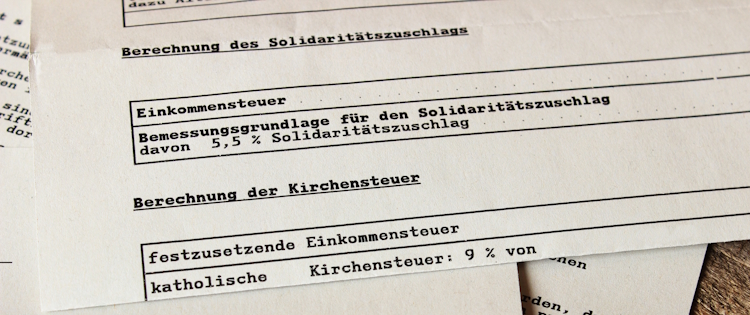
While not as old as Stamp Duty in the UK, Germany has its own long-standing tax tradition – the Kirchensteuer, or church tax. Formalised in 1919 under the Weimar Constitution, but with older roots in medieval obligations to fund churches, it remains a core part of the German tax system today.
Members of recognised religious groups – primarily Catholic, Protestant, and Jewish communities – pay 8-9% of their income tax as church tax, automatically deducted through payroll. The tax office handles the admin, and over €13 billion was collected this way in 2022.
To stop paying, individuals must formally leave their church in person, in a process called Kirchenaustritt. This involves explaining to the priest and the rest of the congregation exactly why you're leaving, and what you hope to do with your extra money. This last sentence isn't true, but imagine if it was. Chilling stuff.
🏡 3. Property and land taxes
Most countries have some form of property or land tax, and most people don't love them. But they've been around longer than you might think. In the Roman empire, landowners were subject to the tributum soli, a tax levied directly on agricultural land. It was assessed based on the size and fertility of the land, and recorded through imperial censuses. This is ancient history, literally, but it's also the basis for modern law.
Take the UK's council tax, introduced in 1993 after the demise of the poll tax. It's technically based on property value, but those values haven't been updated since 1991, the same year Bart Simpson's seminal "Do The Bartman" was released.
This potential unfairness is compounded by council tax rates being fixed in odd ways. For instance, Buckingham Palace, at band H, pays the highest rate of council tax, but its council is in the wealthy neighbourhood of Westminster, which charges some of the lowest council tax in the country. Consequently, Buckingham Palace pays less council tax than 46% of English households.
Critics have long called it outdated and regressive. A £1 million home can attract a lower effective rate than one worth £250,000. And, as mentioned, if it's a wealthy area, there's less onus of collecting money via council tax, and the very rich might benefit the most. But, on the other hand, it'd be really nice to not have to pay any of it at all.
🍷 4. Excise duties on alcohol
Taxes on alcohol have been around a long time, and they've rarely gone down smoothly. Certainly not as smoothly as a scotch on the rocks, which goes down a lot smoother than the bill, which is large, due to the taxes on alcohol.
In the UK, excise duties on spirits were introduced as early as 1643 to fund the English Civil War. They've stuck around ever since, now applied to beer, wine and spirit. Unlike the council tax, these are updated every year.
America's first federal domestic tax wasn't on land or income, it was on whiskey, and it didn't go down easily. Certainly not as easily as a tall glass of hard lemonade, and you know what the bill's like for one of those.
That 1791 "whiskey tax" led to what's now known as the Whiskey Rebellion, a full-blown armed uprising by farmers in western Pennsylvania who distilled grain into liquor and didn't take kindly to being taxed in cash they often didn't have. They saw it as taxation without representation, and some 500 rebels attacked the home of a federal tax inspector. George Washington responded by sending in the army, quashing the revolt and showing that the new federal government meant business.
The tax was repealed in 1802, and it's easy to imagine the kind of celebrations that might've happened.
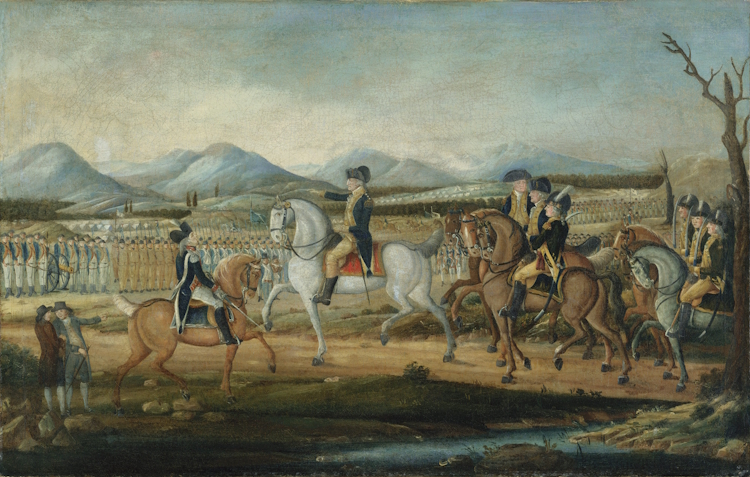
George Washington on his way to suppress the Whiskey Rebellion
🚢 5. Customs and import duties
Today's customs and import duties might feel like modern border bureaucracy, but their DNA goes back thousands of years.
In ancient Rome, merchants moving goods across borders, rivers, and bridges paid the portorium – a transport and import/export tax first recorded in 508 BC. Later expanded under Tiberius, it raised funds for the imperial treasury, and was levied at up to 2.5% of the cargo's value.
So, while tariffs might be in the news today, the principles are very old – very old, indeed. They're some of the oldest principles we've ever seen, folks. You're going to be sick of how old these principles are when we're through with them.
🧠 Final thoughts
Taxes may change names, rates, and rationales, but the core idea endures – find something people value, and charge them for it. You might fund a cathedral, or a war.
Sometimes, it just keeps the bins collected. But that's important! It's potentially the most important thing in your life. It's probably not, but it might be.
You need to sign in or register before you can add a contribution.